
Malaysia is one of Southeast Asia’s easiest countries for first-time travelers because it combines modern transport, English-friendly cities, diverse food, and quick access to beaches, rainforest, temples, and heritage streets.
This plan avoids a generic countrywide bucket list and focuses on approachable, high-reward places and experiences that help new visitors understand Malaysia’s culture, logistics, and travel rhythm without feeling rushed.
Petronas Twin Towers and KLCC Park, Kuala Lumpur
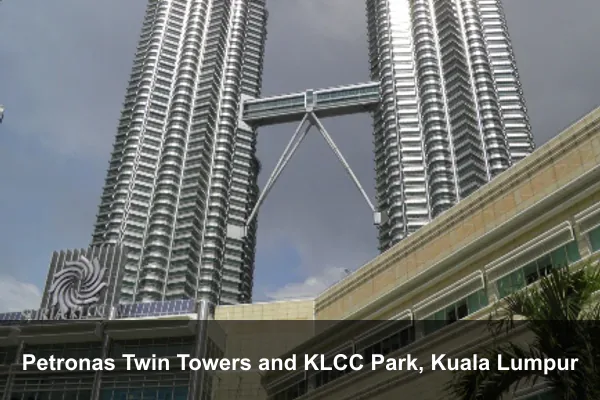
The Petronas Twin Towers are an ideal first stop for travelers landing in Malaysia, offering an immediate sense of the country’s confident, modern character right in the heart of Kuala Lumpur. Their gleaming steel facades and iconic skybridge symbolize the city’s rise as a Southeast Asian hub, while the surrounding KLCC precinct makes orientation easy with direct LRT access, walkable links to Suria KLCC mall, and clear sightlines that help newcomers get their bearings.
Visitors can ride to the observation deck for sweeping skyline views, then unwind in the landscaped KLCC Park below, where jogging paths, a wading pool, and shaded benches frame the towers from ground level. As dusk settles, the Lake Symphony fountain show comes alive with choreographed water and lights against the illuminated towers, giving first-time travelers a memorable introduction to Kuala Lumpur’s blend of nature, architecture, and easygoing city life.
Travel tip: Book tower observation tickets online in advance, then leave time for the free KLCC Park fountain show in the evening.
Best time to visit: Weekday late afternoon into evening, especially outside Malaysian public holidays.
Ticket price: KLCC Park is free; Petronas Twin Towers observation tickets are paid and prices vary by age and residency.
Batu Caves, Selangor
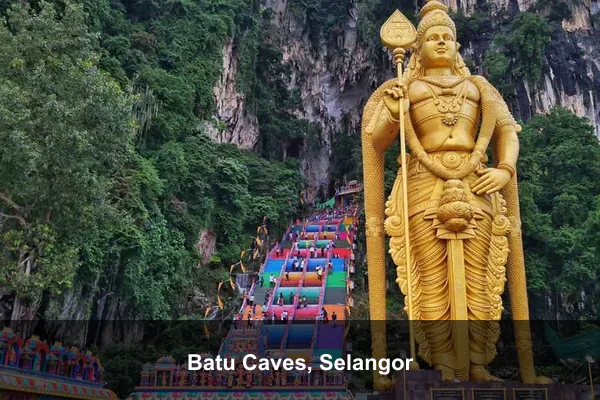
Batu Caves is one of Malaysia’s most iconic landmarks and an essential stop for first-time travelers seeking culture without straying far from the capital. The towering golden statue of Lord Murugan, the rainbow-painted 272-step staircase, and the limestone hills behind it create a striking scene that captures the country’s vibrant Hindu heritage in a single frame, all just a short ride from central Kuala Lumpur.
Visitors can climb the colorful steps to explore the main Temple Cave, watch long-tailed macaques along the railings, and admire shrines tucked inside the cathedral-like cavern. Photographers will find endless angles between the statue, the staircase, and the cliff backdrop, while curious travelers can venture into nearby smaller caves or browse the souvenir stalls and Indian eateries clustered near the base.
Travel tip: Dress modestly, bring water, and use the KTM Komuter train from KL Sentral to avoid traffic.
Best time to visit: Early morning, ideally before 9:00 AM, and outside the busiest Thaipusam festival period unless attending intentionally.
Ticket price: Main temple cave entry is usually free; some smaller cave attractions may charge separate fees.
Merdeka Square and River of Life Heritage Walk, Kuala Lumpur
Merdeka Square is the symbolic heart of Malaysia, the very ground where the Union Jack was lowered and the Malayan flag first rose in 1957. For first-time travelers, it offers a rare concentration of landmark sights in a compact, walkable area, with the Mughal-inspired Sultan Abdul Samad Building, the timber-domed Masjid Jamek, and the revitalized confluence of the Klang and Gombak rivers all within easy reach. The Heritage Walk gently introduces Kuala Lumpur’s layered identity, blending colonial, Islamic, and modern Malaysian stories without requiring a guide or ticket.
Visitors can stroll the manicured lawn beneath one of the tallest flagpoles in the world, photograph the copper domes and Moorish arches across the road, and follow the River of Life promenade where blue-lit fountains and walkways frame the historic mosque. Information panels along the route trace independence-era milestones, while nearby stops like the Kuala Lumpur City Gallery and Textile Museum reward curious wanderers. Pedestrian bridges connect the square to Central Market and Chinatown, making it a natural starting point for exploring the old city on foot.
Travel tip: Start at Masjid Jamek station and walk in daylight; use shaded breaks because the route can feel hot at midday.
Best time to visit: Morning between 8:00 AM and 10:30 AM or late afternoon before sunset.
Ticket price: Free for the outdoor walk; museum or gallery stops nearby may charge small fees.
George Town Street Art and Clan Jetties, Penang
George Town’s UNESCO-listed core is one of the easiest places in Malaysia for first-time travelers to fall in love with, because its compact grid of pastel shophouses, painted murals, and breezy waterfront jetties can all be explored on foot in a single morning. The mix of Chinese, Malay, Indian, and colonial influences is visible in every doorway, temple, and hawker stall, giving newcomers a gentle but vivid introduction to Penang’s multicultural character without needing a tour or prior planning.
Visitors can hunt down Ernest Zacharevic’s famous wall art around Armenian and Ah Quee streets, peek into incense-scented clan temples, and wander the wooden walkways of Chew Jetty, where stilt homes still sit above the harbor. Between stops, it is easy to pause for char kway teow, asam laksa, or an iced white coffee at a kopitiam, and to watch trishaw uncles drift past as the heritage zone slowly wakes up.
Travel tip: Walk or use the free CAT bus in the heritage zone, and visit the jetties respectfully because people still live there.
Best time to visit: Dry-season mornings from December to March, or any day before 10:00 AM for cooler streets.
Ticket price: Free to explore; food, trishaws, and guided tours cost extra.
Kek Lok Si Temple, Penang
Kek Lok Si is Southeast Asia’s largest Buddhist temple complex and a defining landmark of Penang, rising in tiers up Air Itam hill just beyond George Town. First-time travelers come here for the rare combination of grand religious architecture, sweeping views over the island, and an atmosphere that feels both spiritual and welcoming to curious newcomers.
Visitors can wander prayer halls, turtle ponds, and ornate gardens before riding the inclined lift up to the towering Kuan Yin bronze statue and the seven-tier Pagoda of Rama VI, which blends Chinese, Thai, and Burmese design. From the upper terrace the panorama of Penang’s coastline and George Town skyline is especially striking in the soft light of late afternoon.
Travel tip: Use a ride-hailing car or local bus to Air Itam, and combine the visit with nearby laksa stalls if timing allows.
Best time to visit: Late afternoon on weekdays; evenings during Lunar New Year lighting season are popular but crowded.
Ticket price: Temple grounds are mostly free; inclines, pagoda access, or special areas may charge small separate fees.
Langkawi SkyCab and SkyBridge, Kedah
Langkawi SkyCab and SkyBridge in Kedah offers first-time travelers in Malaysia one of the easiest ways to experience a dramatic rainforest-and-island panorama without the strain of a real mountain trek. The cable car climbs Gunung Mat Cincang, one of the oldest mountains in Southeast Asia, and on a clear morning you can see emerald islets scattered across the Andaman Sea, layered jungle ridges, and even the coast of southern Thailand in the distance.
At the top, visitors can step onto the curved SkyBridge suspended high above a forested gorge, pause at the SkyDome and viewing platforms for photos, and feel the cool highland air that contrasts sharply with the beach heat below. The surrounding Oriental Village base station also has small shops, cafes, and family attractions, making it an easy half-day stop that pairs well with island-hopping or a relaxed Langkawi beach itinerary.
Travel tip: Check weather before going because wind or storms can pause cable car operations, and buy tickets early in peak season.
Best time to visit: Morning during the drier months from December to March, before tour groups build up.
Ticket price: Paid attraction; prices vary by package, nationality, and express-lane options.
Kilim Karst Geoforest Park Mangrove Tour, Langkawi
Kilim Karst Geoforest Park offers first-time travelers in Malaysia a rare chance to glide through one of Southeast Asia’s most striking natural landscapes, where towering limestone cliffs rise straight from emerald waterways. Recognized by UNESCO for its geological significance, the park combines ancient rock formations, tangled mangrove forests, and hidden sea caves into a single, easy-going boat journey that feels worlds away from Langkawi’s beaches.
Onboard a small motorboat, visitors weave between mangrove tunnels, pause at bat caves, and watch for brahminy kites, white-bellied sea eagles, macaques, and mudskippers along the banks. Many tours include a stop at a floating fish farm and a quiet swim spot, giving travelers a relaxed mix of wildlife spotting, photography, and gentle exploration suited to all ages.
Travel tip: Choose a licensed shared boat tour if traveling solo or on a budget, and avoid feeding wildlife.
Best time to visit: Morning departures during calm weather, especially outside heavy rain periods.
Ticket price: Prices vary by private or shared boat, route length, and operator.
Kinabatangan River Wildlife Cruise, Sabah
The Kinabatangan River winds through Sabah’s lowland rainforest, offering first-time travelers one of Borneo’s most accessible wildlife encounters. Instead of strenuous jungle trekking, visitors glide along the water in small boats, letting the forest’s residents come into view from a comfortable, shaded vantage point. The dense riverbanks concentrate an extraordinary range of species, making sightings far more reliable here than in deeper, harder-to-reach parts of the island.
Cruises typically reveal proboscis monkeys lounging in riverside trees, long-tailed macaques, hornbills in flight, and the occasional pygmy elephant or saltwater crocodile along the muddy banks. Guides point out kingfishers, monitor lizards, and orangutan nests high in the canopy, while night cruises bring sleeping birds and glowing insect eyes into focus. Staying at a riverside eco-lodge lets travelers join multiple cruises a day and absorb the rhythm of the rainforest between outings.
Travel tip: Pack binoculars, insect repellent, and a light rain jacket; book accommodation that includes boat cruises.
Best time to visit: March to October for drier conditions, with dawn and late-afternoon cruises offering the best wildlife activity.
Ticket price: Prices vary widely by lodge package, cruise count, transfers, and guide quality.
Bako National Park, Sarawak
Bako National Park is one of Sarawak’s most rewarding introductions to Borneo’s wild side, packing rainforest, sandstone cliffs, mangroves, and quiet beaches into a compact peninsula reachable by a short boat ride from Kuching. For first-time travelers, it offers a rare chance to meet the endemic proboscis monkey in the wild without committing to a long expedition, making it an easy yet authentic taste of Malaysian nature.
Visitors can choose from a network of color-coded trails that suit different fitness levels, leading to hidden coves, sea stacks, and pitcher plant clusters along the way. Mornings and late afternoons are best for spotting proboscis monkeys, silvered langurs, bearded pigs, and macaques near the park headquarters, while guided night walks reveal frogs, insects, and the occasional flying lemur.
Travel tip: Reserve park accommodation or day-trip permits early, and bring cash for boat transfers from Bako Bazaar.
Best time to visit: Dryer months from April to September, with morning boat transfers when tides and weather are more reliable.
Ticket price: Paid park entry plus separate boat transfer; total cost varies by nationality, group size, and route.
Melaka River Walk and Jonker Street, Melaka
Melaka River Walk and Jonker Street form the cultural heart of a UNESCO-listed city where Malay, Chinese, Portuguese, and Dutch histories visibly overlap. For first-time travelers, it offers an easy, walkable introduction to Malaysia’s heritage side, with colorful shophouses, lantern-lit lanes, and a slow riverside pace that contrasts nicely with Kuala Lumpur’s bustle.
Along the river, visitors can stroll past murals and cafes, hop on a short cruise, or explore Peranakan mansions and small museums tucked into the old quarter. Jonker Street itself comes alive after dark with street food stalls, antique shops, and live performances, making it an easy place to wander, snack, and soak in the atmosphere without a strict itinerary.
Travel tip: Visit on a weekday for calmer sightseeing or on a weekend night if the Jonker Street market is a priority.
Best time to visit: Late afternoon into evening; Friday to Sunday evenings for the night market atmosphere.
Ticket price: River walk and Jonker Street are free; river cruises, museums, and food purchases cost extra.
